Neutron Irradiation Services
High‑Flux Neutron Sources for Advanced Research & Testing


Real World Validation
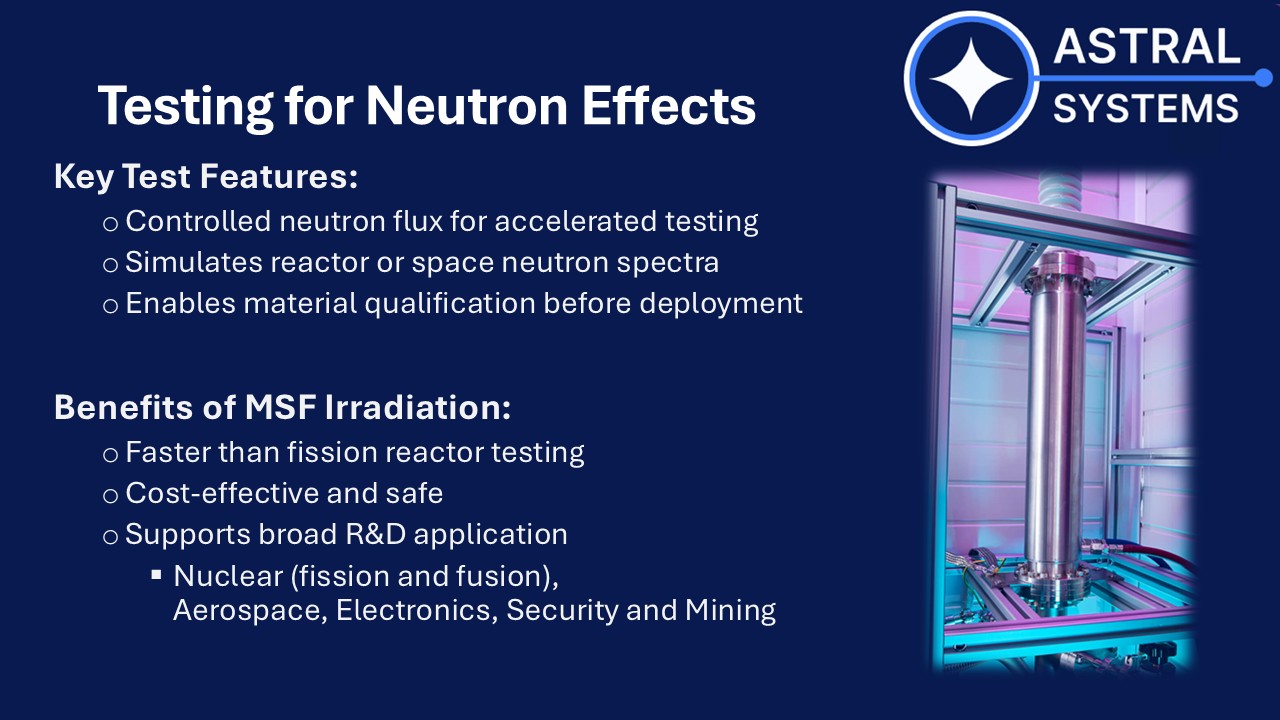
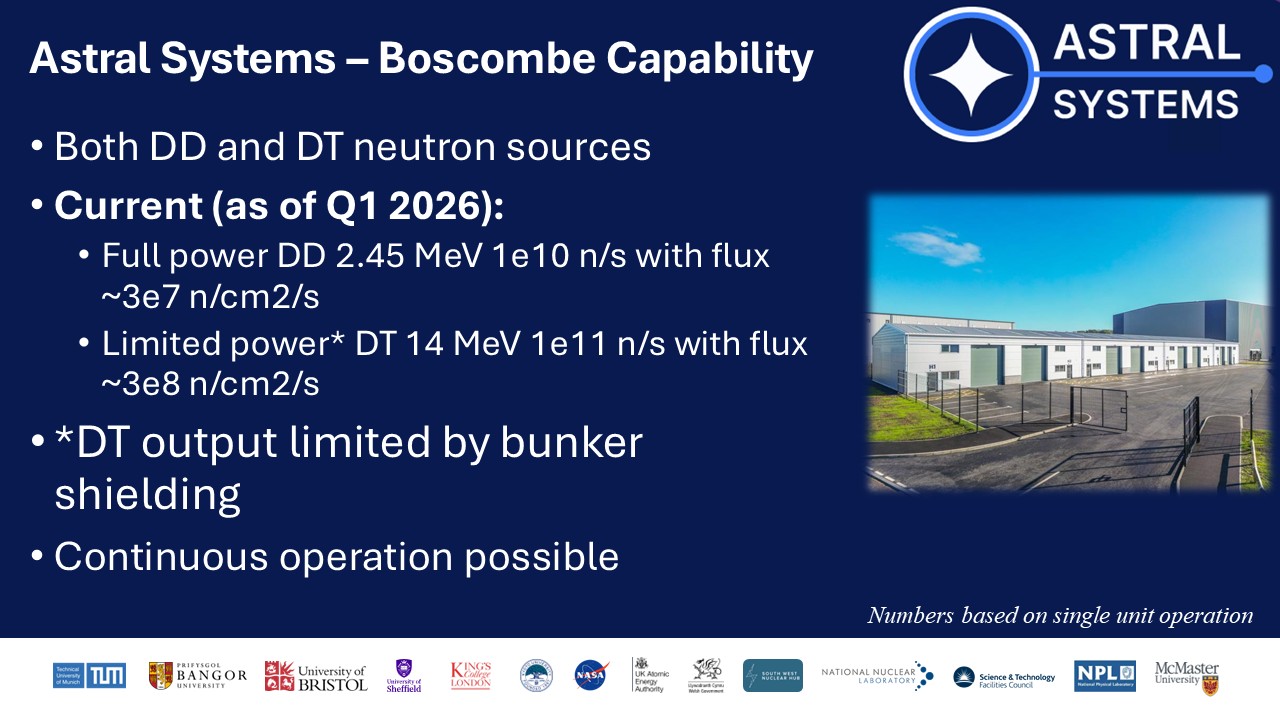
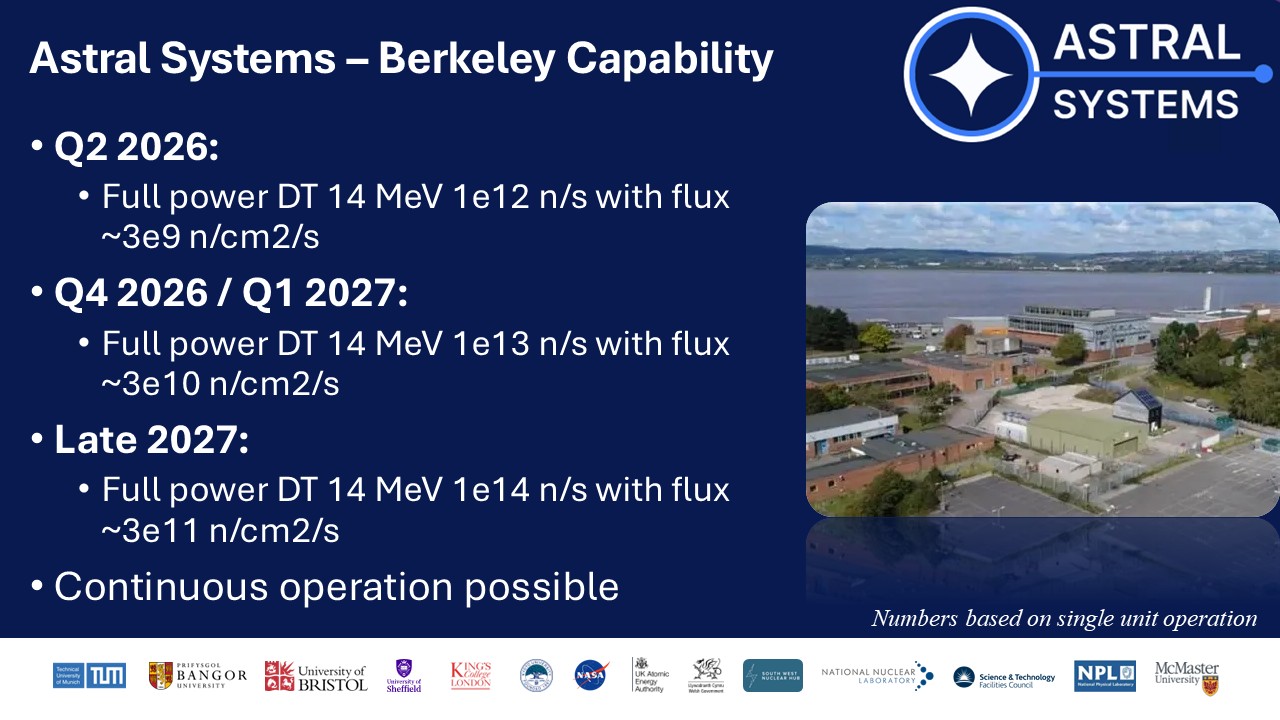
Advanced simulation tools underpin modern engineering across fusion, fission, aerospace, defence, electronics, security, and materials science. However, simulations alone cannot fully capture the complex, coupled effects of neutron irradiation on real materials and systems. Access to controlled D–D (2.45 MeV) and D–T (14.1 MeV) neutron sources is essential to provide analogue environments that complement, calibrate, and verify computational models.
Astral Systems’ neutron irradiation services provide experimental access to neutron spectra directly relevant to fusion and highenergy radiation environments. This enables organisations to move beyond theoretical predictions and obtain empirical data on material performance, component degradation, and system behaviour under neutron exposure.
Key uses of Neutron Irradiation

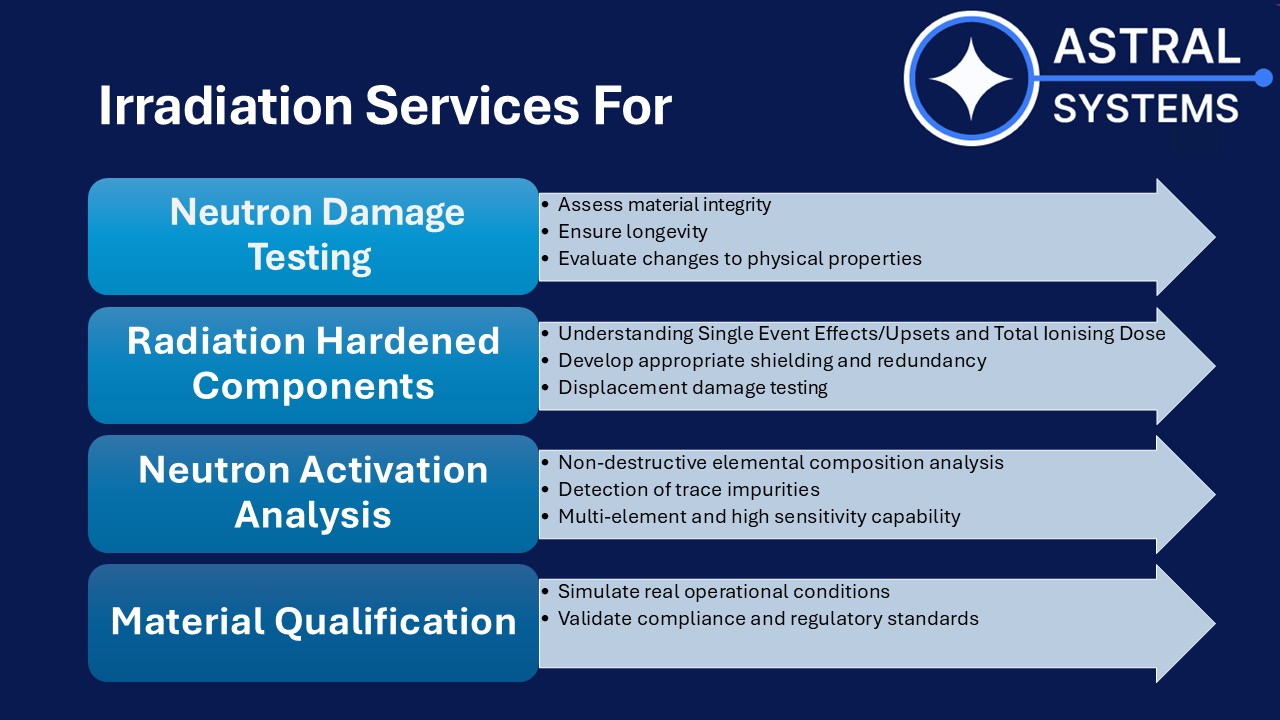
Neutron damage and durability testing
Assessing displacement damage, embrittlement, swelling, and changes in mechanical or electrical properties under prolonged neutron exposure.
.svg)
Material qualification and regulatory validation
Simulating operational neutron environments to support qualification, licensing, and certification of materials for nuclear and high radiation applications.

Neutron activation analysis (NAA)
Non-destructive elemental and trace impurity analysis for research, quality control, forensics, and geological applications.

Radiation hardened electronics and components
Investigating single event effects (SEEs/SEUs), displacement damage, and total ionising dose impacts to support robust design, shielding strategies, and redundancy. Together, these capabilities allow organisations to reduce uncertainty, derisk deployment, and accelerate development cycles by anchoring simulations to experimentally verified data.
Why Astral Systems for Neutron Irradiation?
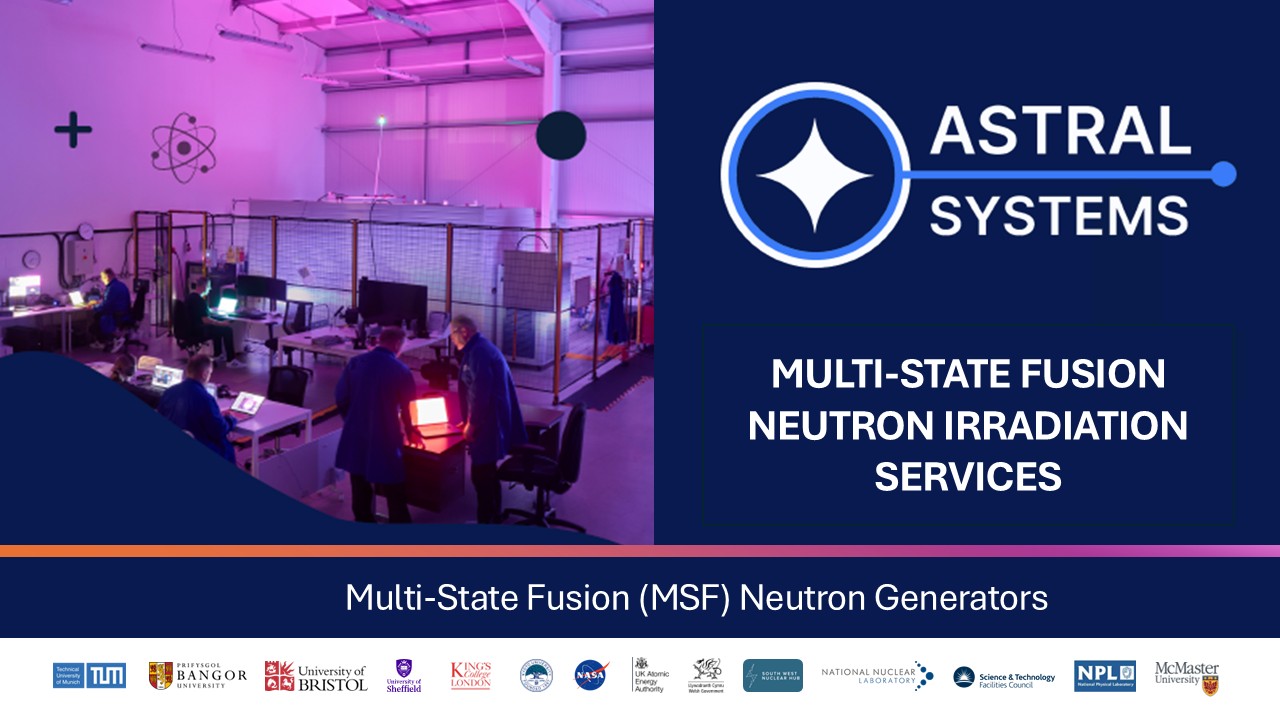
Astral Systems delivers neutron irradiation services using compact multistate fusion (MSF) reactors, designed to provide flexible, high performance experimental environments tailored to customer needs.

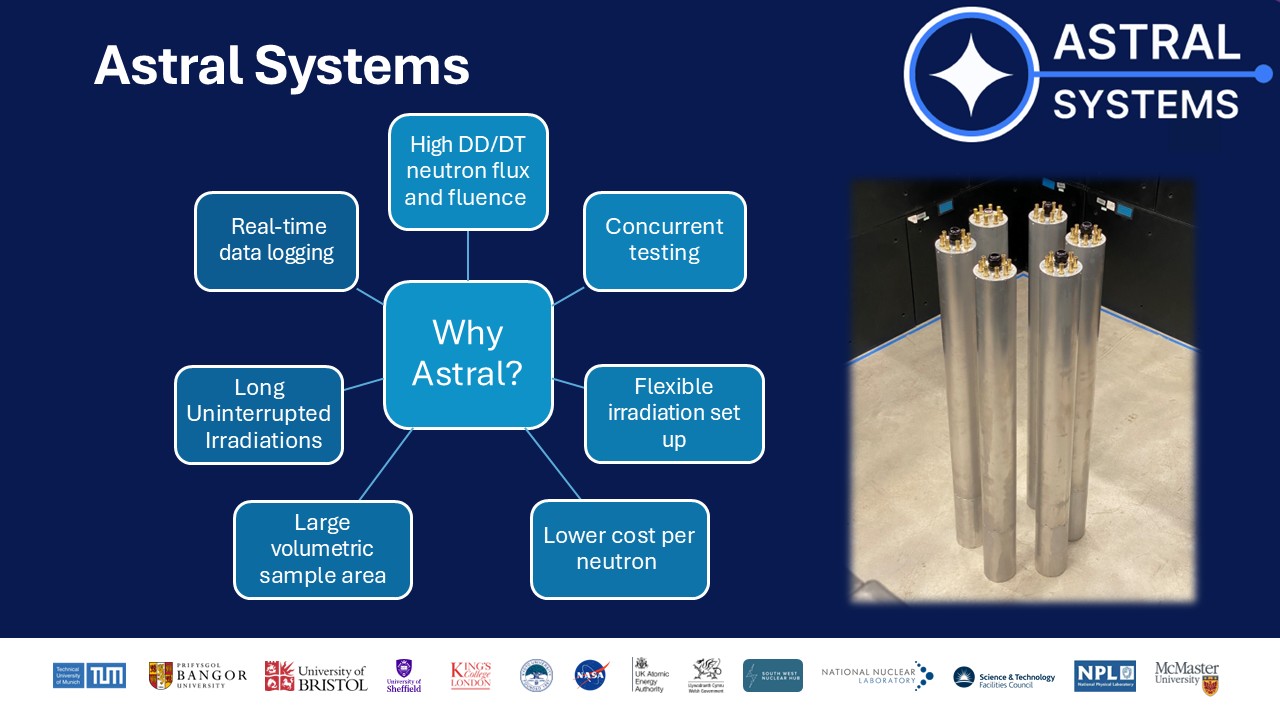
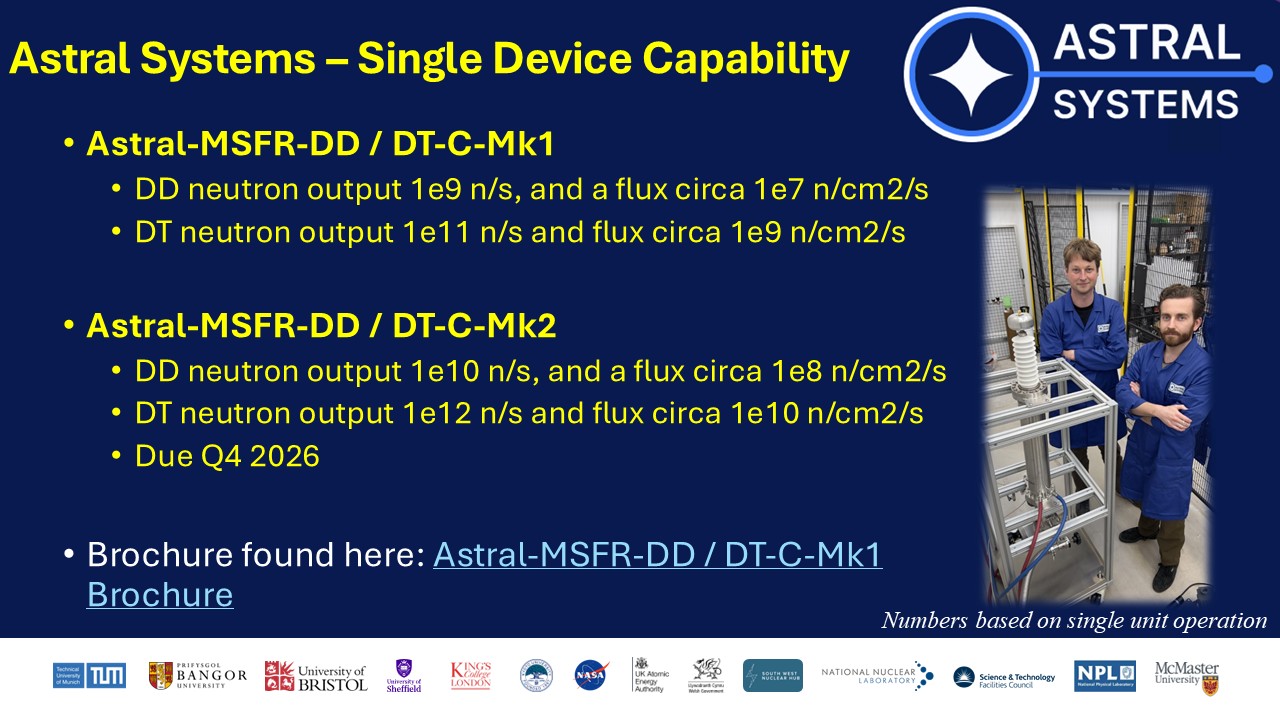
High D–D and D–T neutron flux and fluence
Enabling accelerated testing and meaningful data generation within practical timescales.

Volumetric neutron source
Providing irradiation conditions that better represent real operational environments compared with pointlike sources and allowing large samples.
.svg)
Flexible irradiation configurations
Experimental setups can be adapted to suit different materials, components, and test objectives.

Long, uninterrupted irradiation campaigns
Supporting studies that require continuous exposure for larger fluences to observe cumulative effects.

Concurrent sample testing
Multiple samples can be irradiated simultaneously, improving throughput, experimental consistency and cost.

Realtime data logging
Enabling detailed monitoring and correlation of irradiation conditions with experimental outcomes. These attributes make Astral’s facilities suitable for both exploratory R&D and structured qualification programmes across multiple sectors.